
Emergency & Post-Flood Mold Remediation in Lake Charles, LA
Post-flood mold in Lake Charles follows a pattern people here know too well: water comes in from a hurricane, a stalled downpour or a bayou over its banks, the power and the help are slow to arrive, and by the time the house is opened up the drywall above the waterline is already speckled. Lake Charles Mold Experts sets up the work after a flood or storm for homes and businesses across Calcasieu Parish: drying where drying can still save materials, and an independent assessment plus a separate remediation contractor where growth has started. Call (337) 570-2420.
Call (337) 570-2420 Request a callback
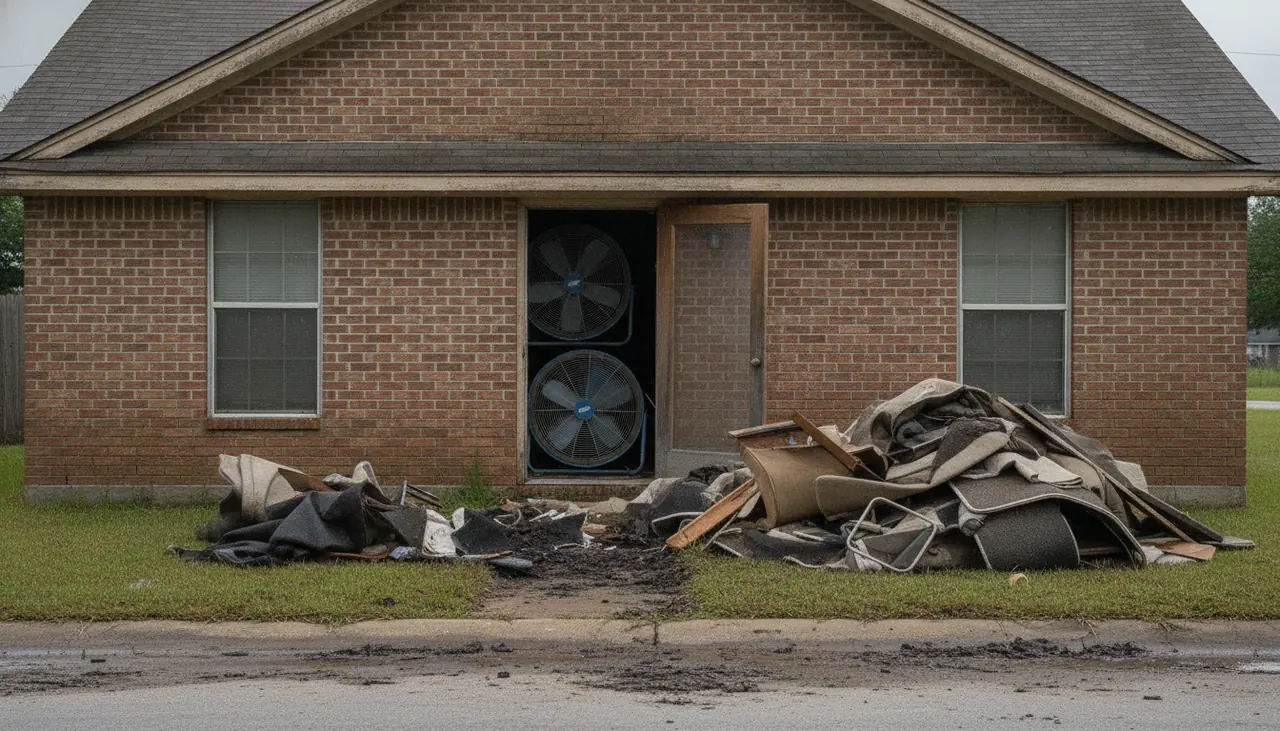
Post-flood timing: what changes after the first two days
The Louisiana Department of Health advises that if you cannot dry your home, furniture and other belongings within 24 to 48 hours, you should assume you have mold growth. Inside that window, the job is extraction, removing soaked flooring and pad, and measured drying. Past it, and certainly after outside floodwater, the job becomes a remediation: flood-soaked drywall and insulation are cut out above the waterline, the cavities are cleaned and dried, and the house is checked before it is rebuilt.
How post-flood mold remediation is carried out
- Make it safe. Power to wet circuits stays off until an electrician clears it; standing water is pumped out.
- Record everything. Photos, waterline heights and a list of damaged contents, for the flood claim.
- Assess. An independent assessor maps the wet and moldy areas with readings and writes the removal protocol.
- Remove. A separate remediation contractor cuts drywall and insulation above the high-water mark, removes flooring and cabinets that took floodwater, and bags it all out.
- Clean and dry. Studs and slab are cleaned, then dried with dehumidifiers and air movers to the target in the protocol.
- Check, then rebuild. Someone outside the remediation firm confirms the result before insulation and board go back.
Flooding and storm history behind post-flood mold in Lake Charles
May 17, 2021. Lake Charles Regional Airport recorded 12.49 inches of rain that day, about six inches of it in two hours; in the airport's daily record since 1961, only one day in May 1980 was wetter. The flood produced 1,586 flood-insurance claims in Calcasieu Parish, 1,174 of them inside the City of Lake Charles, more than either 2020 hurricane.
Laura and Delta, 2020. Laura made landfall near Cameron on August 27, 2020 as a Category 4 hurricane with 130-knot winds, and NHC estimated 3 to 6 feet of surge water above ground in the Lake Charles area. Delta followed on October 9, coming ashore near Creole, and put 9.53 inches of rain on the airport in one day. Between August 2020 and August 2021 the parish was included in six major disaster declarations.
Rita and Ike. Rita's surge in 2005 pushed up the Calcasieu River until it reached Interstate 10 in places, with about 6 feet of water in parts of downtown, and Ike in 2008 set the record of 9.5 feet on the Lake Charles tide gauge. Each of those storms produced more than a thousand flood-insurance claims in the parish.
Flood insurance and storm claims after a flood
Water that rises from outside is a flood-insurance matter, usually through FEMA's National Flood Insurance Program rather than the homeowners policy. The flood maps now in effect date from May 16, 2019 for unincorporated Calcasieu Parish and February 18, 2011 for Lake Charles, Sulphur and Westlake. Policies in the unincorporated parish carry a Community Rating System discount (Class 8, 10% in high-risk zones), while the City of Lake Charles has been at Class 10, with no discount, since April 2023.
Whichever policy applies, the adjuster will want photos taken before anything was removed, the drying records and the written assessment. Keep copies of all three.
The two-firm rule still applies after a flood
Disaster or not, La. R.S. 37:2158(A)(23) bars a mold remediation contractor from performing both the assessment and the remediation on the same property, or from owning an interest in both firms. An offer from one company to both test and clear out the house is, in Louisiana, a violation on the contractor's part. Lake Charles Mold Experts keeps the two separate on every call.
Post-flood mold remediation cost in Lake Charles
A water job caught early is often around $2,500. Once growth has started, remediation is added: $1,600 to $5,000 for one room and $1,600 to $8,500 for a crawl space. A house still holding growth from the 2020 hurricanes usually runs from $7,500 to $28,000 or more, because more of the structure has to be opened. A clearance test is $200 to $450. All ranges are on the cost page; the written price follows the assessment.
Calling after a flood or storm
Ring (337) 570-2420 and say when the water came in, how high it rose, whether it was rain through the roof or water from outside, and whether the power is on. Have the claim number handy if you have one. The line takes details at any hour, and the form below does the same.
Post-flood and storm mold questions
How soon after a flood does mold start growing?
The Louisiana Department of Health says to assume mold growth if things cannot be dried within 24 to 48 hours. Call (337) 570-2420 as early as you can after the water goes down.
Can a flooded house be saved?
Usually, yes. The framing and slab are cleaned and dried, and the soaked drywall, insulation, flooring and cabinets are replaced. Call (337) 570-2420 to start with an assessment.
How high should drywall be cut after a flood?
Above the waterline, at the height the moisture readings show is wet, which is often higher than the visible mark. Phone (337) 570-2420 so the cut line is set by readings, not guesswork.
Does flood insurance cover mold after a flood?
Flood policies set their own terms for mold that follows a flood, including what the owner was expected to do to dry the house, so read yours and ask the adjuster. Call (337) 570-2420 and keep your records for the adjuster.
Is homeowners insurance or flood insurance the right claim?
Rain through a storm-damaged roof is usually a homeowners claim; rising water from outside is a flood claim. Call (337) 570-2420 if you need the assessment written for either.
Can one company assess and remove mold after a storm?
Not in Louisiana. The assessment and the remediation must come from separate firms (La. R.S. 37:2158(A)(23)). Call (337) 570-2420 and the two firms are booked separately.
Request a Callback
Easier to type than to talk, or calling late in the evening? Fill in the boxes below and the call back comes to you.
Would a phone call suit you better? Ring (337) 570-2420 at any hour and leave the address and what you have found; a call back follows.
Flood, storm or burst pipe?
Stop the water, take photos, and call (337) 570-2420. Extraction and drying if it is early, remediation if it is not.
Call (337) 570-2420